My Human Being

Review by Laura Di Piazza

Conceptual artist Rebecca Weisman inserts herself into the landscape of her art in My Human Being, which is currently on exhibit at the Julian Scott Gallery, Johnson State College, in Vermont until March 10th. With 3 simple words, My Human Being, Weisman investigates our changing environment and how one tries to both capture and let go of time and one’s own placement within it. This multi-media installation engages viewers with film imagery that have been 5 years in the making.  The installation encompasses a 5 channel surround sound score that includes white noise, recorded speech and the sound of water dripping onto a microphone. The sounds include a wide range from natural to artificial. Gallery director Leila Bandar finds that “there is a visceral quality to the sound element — a drip, drip, drip, the repetitive clacking, the whale-song sound of syllables stretched”. Bandar asks “What do we see when we hear a drip?”.
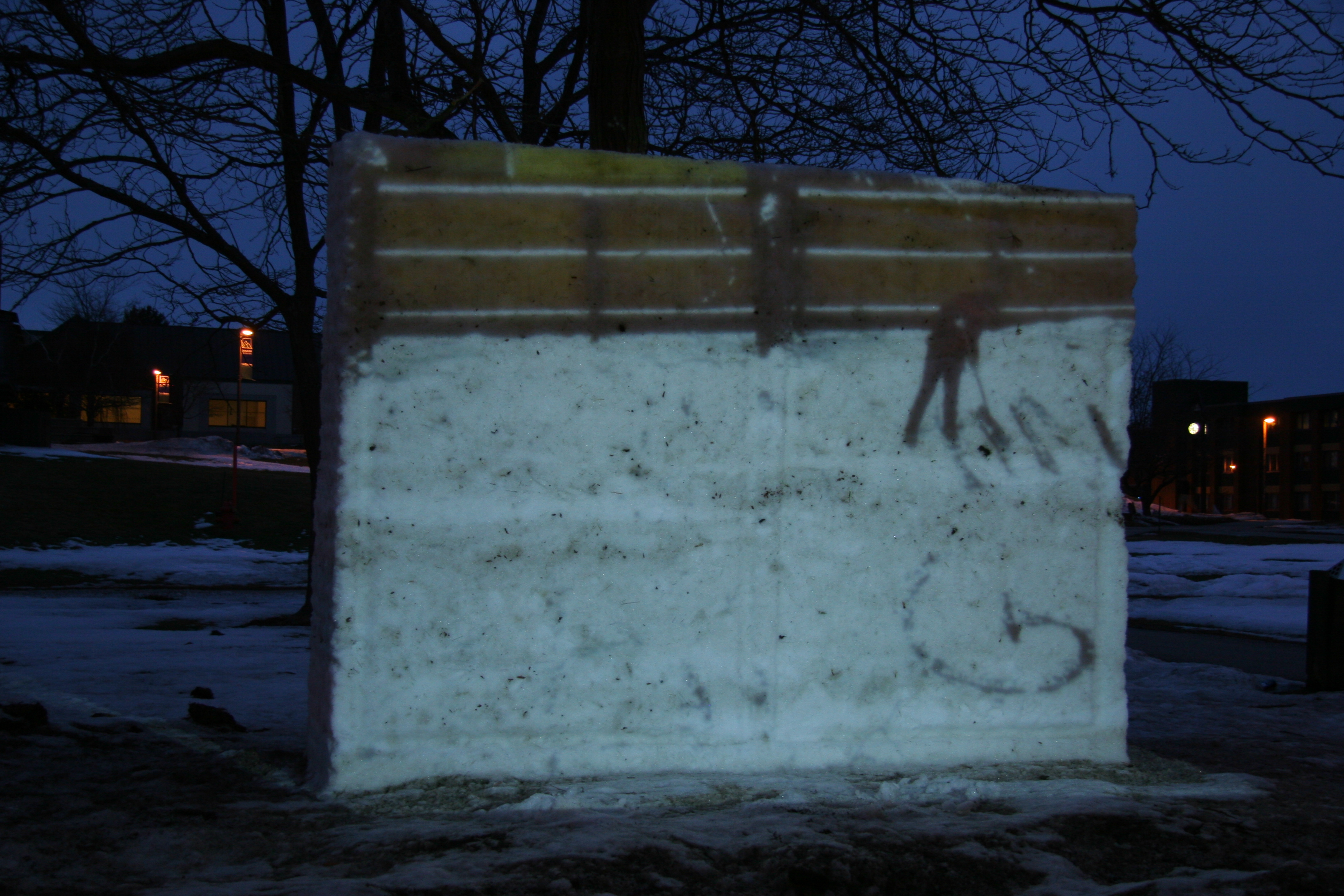
Time is a central element that Weisman records, observes, engages with and disrupts with the construction and dissolving of her inscription, My Human Being, made by using the landscapes available raw materials, her body and shovels. Inside the gallery space a fast motion loop filmed in the spring, summer and fall shows the artist creating, on nature’s canvas,  that which can not be preserved. Through these seasons the inscription’s transformations are many, as the letterforms dance with the environmental forces that move upon, around and eventually through them. The installation also includes an outdoor component of My Human Being in winter that, at night, is projected onto a snow wall sculpture that was constructed by Weisman and Johnson State students.  The snow wall also serves as a chronological monument that will gradually melt over time, thereby erasing the projection itself. Through out the exhibit the artist will continue to carve words into a gallery wall and then project back their recordings. Weisman uses the exhibition time and space itself to continue the dialogue of change and reflection.
I personally experienced that My Human Being invited contemplation on how I feel about the passage of time, especially how I stand and move within it, and my responses to time when I am not actively engaged with it but am simply remembering. Ultimately what resonated with me most about this installation are my questions about how I feel and deal with ‘change’ itself.

Cold Harvest

Some recent work…

Laura Di Piazza, Fence, 2011, mixed media 12″ x 24″
Laura Di Piazza, Bunny Says, 2011, mixed media, 27″ x 23.5″
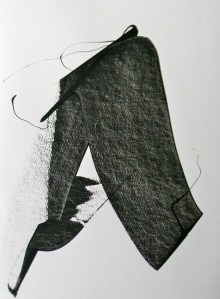
Laura Di Piazza, untitled, 2011, ink and acrylic paint on paper, 14″ x 17″

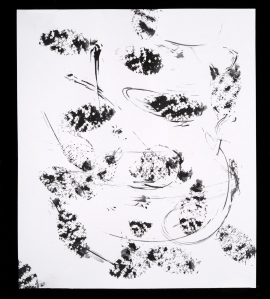
Laura Di Piazza, Goodbye, 2011, sumi ink on paper, 14″ x 17″
laura Di Piazza, In A Moment, 2011, mixed media, 16″ x 20″
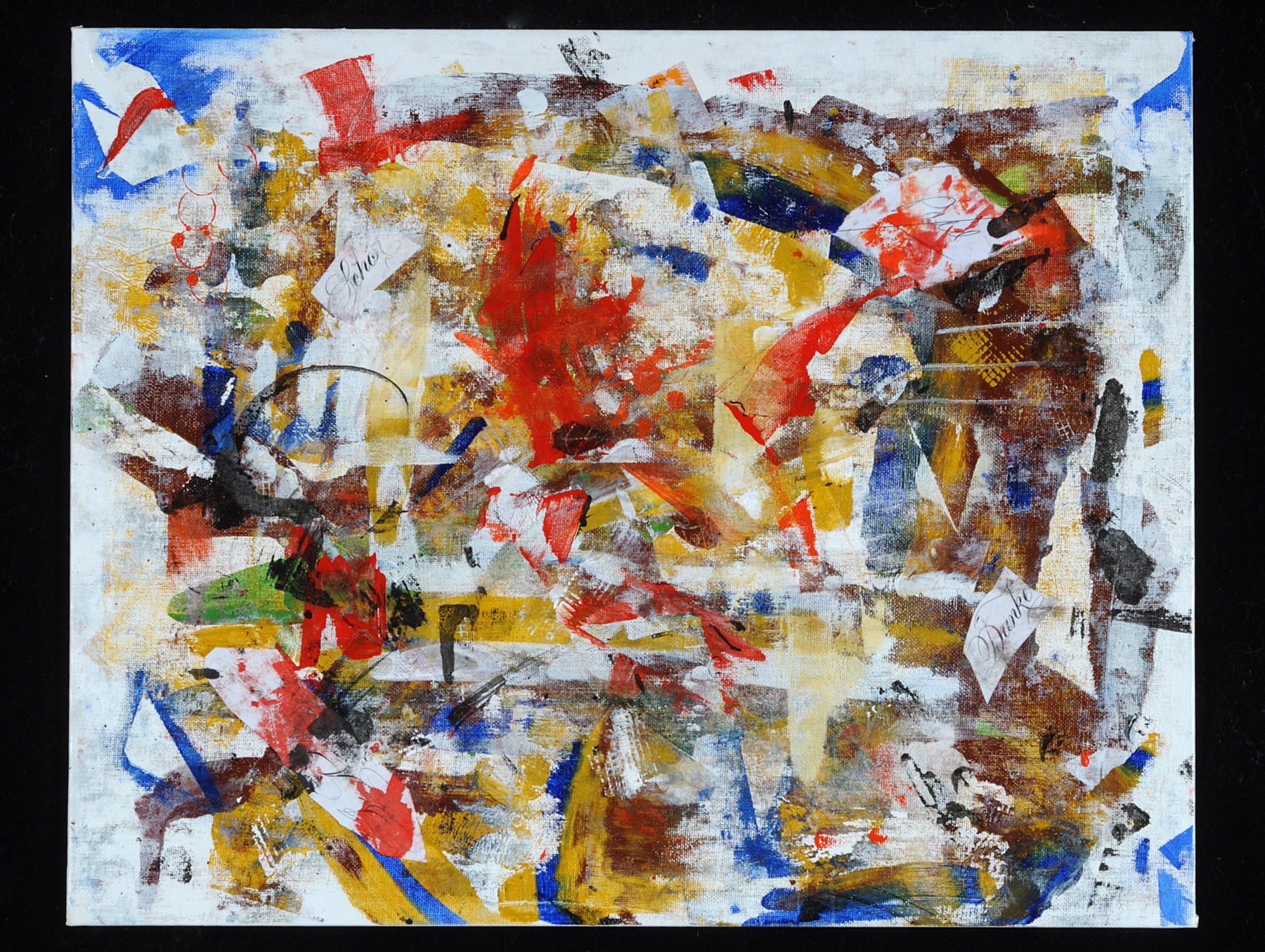
Laura Di Piazza, My Beloved Pain, 2011, acrylic paint, sumi ink, gouache and paper on canvas, 20″ x 24″

Spencerian Script Workshop

Please join me this Thursday 12/8 for a free introductory workshop on Spencerian script at the Kilton Library (80 Main Street, West Lebanon, NH), 6 to 8pm. Supplies will be provided. E-mail, L.dipiazza(at)yahoo (dot)com to reserve a seat.

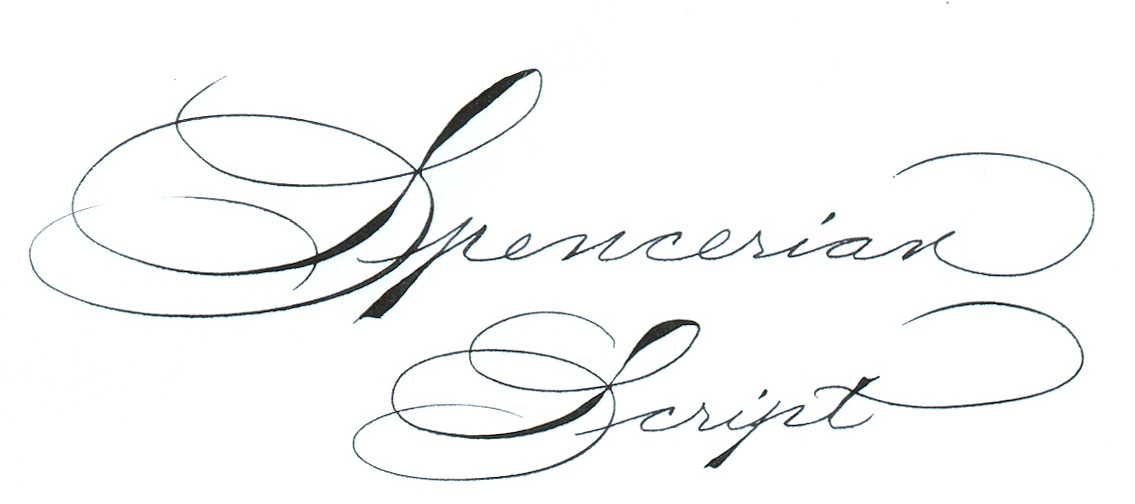
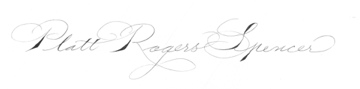
P.R. Spencer (1800-1864): creator of Spencerian Penmanship

Le Havre – Vermont International Film Fest

As published on Thread.

Movie Review: Le Havre

By Laura Di Piazza, for Thread Magazine

When you don’t exist, where are you?

Le Havre, written and directed by Finnish filmmaker Aki Kaurismäki, takes place in the French port town of the title name, where Marcel (André Wilms) lives in the margins of society struggling to make ends meet. Marcel is a shoeshiner who brings home his small earnings to his loving wife Arletty (Kati Outinen) who is, unbeknownst to him, ill. On what appears to be an ordinary day during his lunch break Marcel encounters a young and frightened boy, an illegal immigrant caught in a media frenzy for his capture, named Idrissa (Blondin Miguel). Marcel, poor in funds but rich in heart, assists Idrissa in reuniting him with his family.

While Arletty is soon after admitted to the hospital and demands that Marcel gives her space and time to heal, Marcel begins his work in helping Idrissa. Allies present themselves in unexpected places. The captivating Jean-Pierre Darroussin (also featured at Cannes in the 2011 film Les Neiges Du Kilimandjaro), plays the outwardly cold criminal Inspector Monet, who quietly expresses that “I am ruthless toward crime, but I don’t like to see the innocent suffer.”

Director Kaurismäki brilliantly weaves many outsider characters to unite in the effort of doing what’s right in the face of the faceless machines of immigration laws and the misguided media. Kaurismäki does not mask age at all and artistically expresses the characters’ depth and beauty by giving the camera time to take in their essence. Kaurismäki also incorporates the outsider elements subtly, through a song on vinyl (Stateboro Blues) and literature read out loud (Kafka). Perhaps most strikingly captured in Le Havre, is how each person appears to be fully aware and engaged. From the common task of wrapping a package to determining another human being’s fate, all is done with full concentration.

Another observation of departing from mainstream is how Kaurismäki plays with time in regards to fashion. From Idrissa’s Cosby-like 80’s sweater, to Atletty’s special yellow 50’s dress to Inspector Monet’s head to toe black clothing with 70’s wide collars, no one is trendy here (thank heavens). Also refreshing and pleasing to the eye is the stunning work of cinematographer Timo Salminen who reveals rich hues and expresses crisp depth perception. The cinematography has a retro-like quality and cohesion to it that can remind one of the continuity of music on vinyl records as opposed to the divisions of digital recordings.

The twists and turns of Le Havre are undoubtedly as engaging as getting lost in a new and fascinating city. Kaurismäki turns challenges, like how to raise $3000 Euros quickly for Idrissa’s passage to London, into comical opportunities. The featured ‘trendy charity concert’ is not to be missed. And again it is the not-so-trendy, the otherness, which takes center stage.

One may liken this story to a fairy tale, however if it is believed that most people are good at heart then it is rather a reflection of everyday people following their conscience.

Le Havre was produced by Finnish company Sputnik Oy with co-producers in France and Germany. The film was award the FIPRESCI prize at the 2011 Cannes Film Festival and is Finland’s foreign language Oscar nominee.

Le Havre is featured in the 2011 Vermont International Film Fest.

Copperplate Calligraphy

I’ll be teaching an introduction to copperplate calligraphy workshop this fall at AVA gallery in Lebanon, New Hampshire. See below for the workshop description.  For more information or to register please contact AVA directly.
Introduction to Copperplate Calligraphy workshop at AVA gallery
instructor: Laura Di Piazza
October 26–November 16
Wednesdays, 6:00–8:00pm
Four 2-hour classes
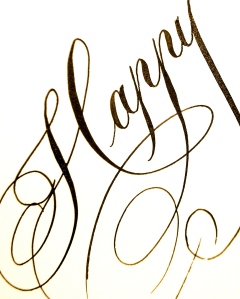
Copperplate calligraphy is a pointed pen hand developed in 17th -century England. We will work with an oblique pen holder, pointed pen nib, India ink and practice pads with grid and slant lines. Our initial focus will be on the amount of pressure applied to our pens to produce thick and thin strokes. We will begin practice with minuscules and later majuscules, which will be grouped according to similar letterforms. All materials will be supplied.

To New Beginnings

There are many admirers of new beginnings. Somehow another chance to get it right or make it better drives us in new directions or deeper into our current path(s). Seasons give us great inspiration of renewal: to sow, plow, reap and rest – the harvest of our lives.

Laura Di Piazza, It Begins With, 2011, ink on paper, 14″ x 17″

Lettering in Art

Laura Di Piazza, Shin, 2011, digital photography (raw image)

On exhibit until September 10th, The Poetry of Shadows exhibit, PhotoPlace Gallery online annex.


Laura Di Piazza, What’s it t’ ya, 2010, mixed media on paper, 8″ x 15″


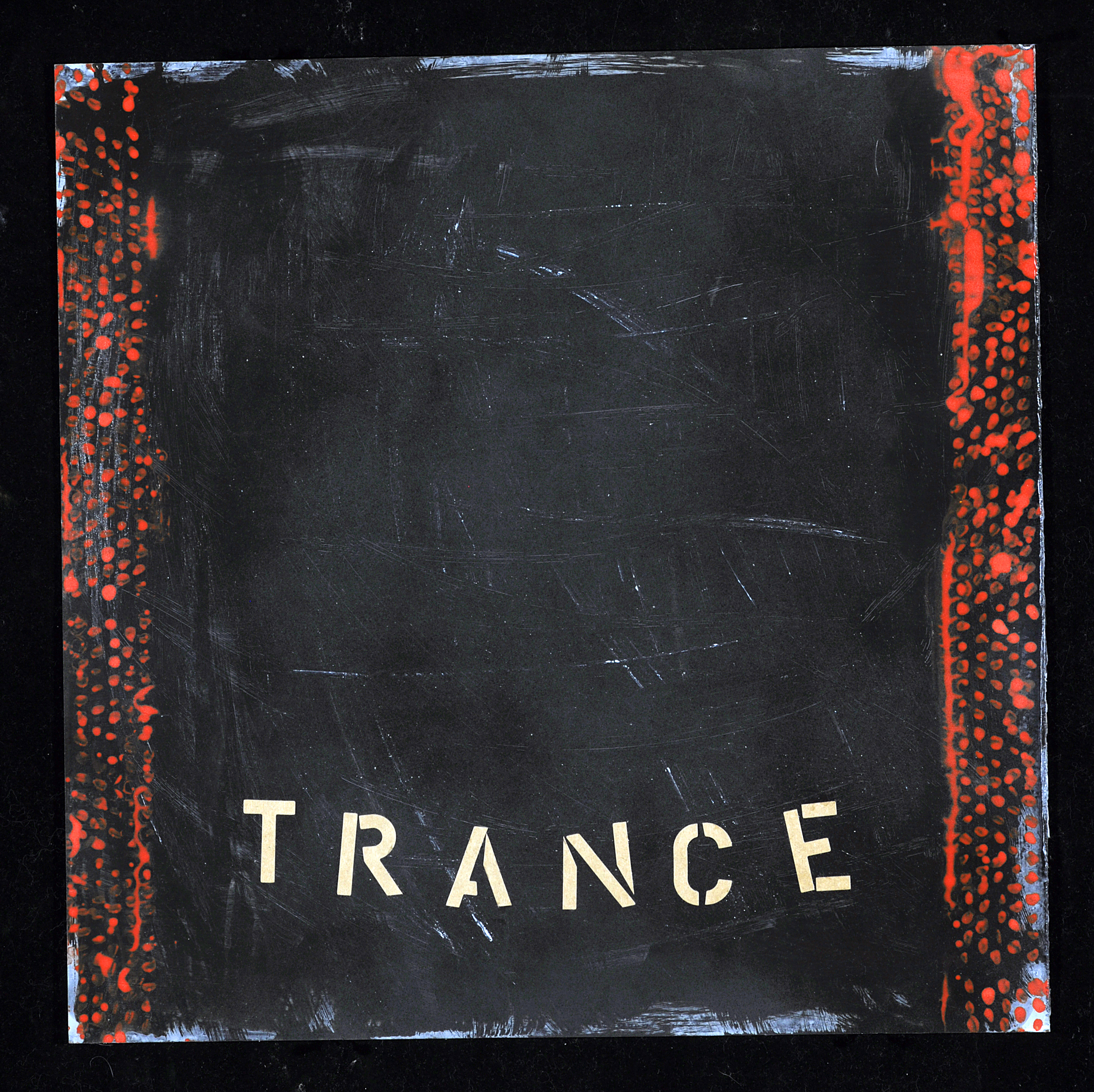
Laura Di Piazza, Trance Dance, 2011, oil and mixed media on panel, 2′ x 2′


Show n’ Tell Typography

Main Street Museum‘s 1st night event:  Show n’ Tell Typography at The Center for Cartoon Studies Friday September 2, 2011, 7pm White River Junction, VT. Speakers: Molly Howard of the Center for Cartoon Studies, Interdisciplinary Artist Laura Di Piazza and designer Taylor Haynes.

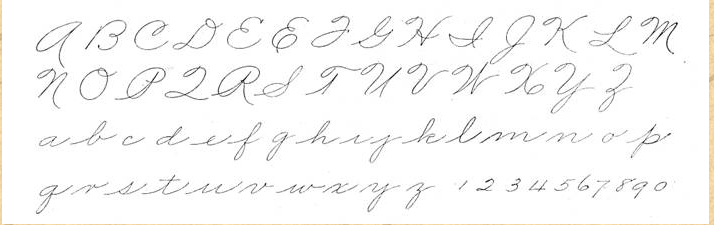
Ornamental Penmanship’s golden age spanned from 1850 to 1925. This “was a unique period in American calligraphic history. Beautiful penmanship was the rule of the day, and the flexible pointed pen was king” (Sull). The Spencerian system of writing was developed by P.R. Spencer in the mid-19th century. Spencerian is considered the first American hand. It is similar to the English Copperplate hand in that they both are scripts and lettered with a pointed pen. The English Copperplate hand is circular-based and each letter consists of thick strokes (shaded) as well as hairlines and is lettered with disconnected strokes. The Spencerian hand, with it’s oval-based forms and light or absent shading in lower case letters and many hairlines throughout the alphabet, is a more fluid hand and is faster to letter.

Ornamental Penmanship by Louis Madarasz
The Declaration of Independence

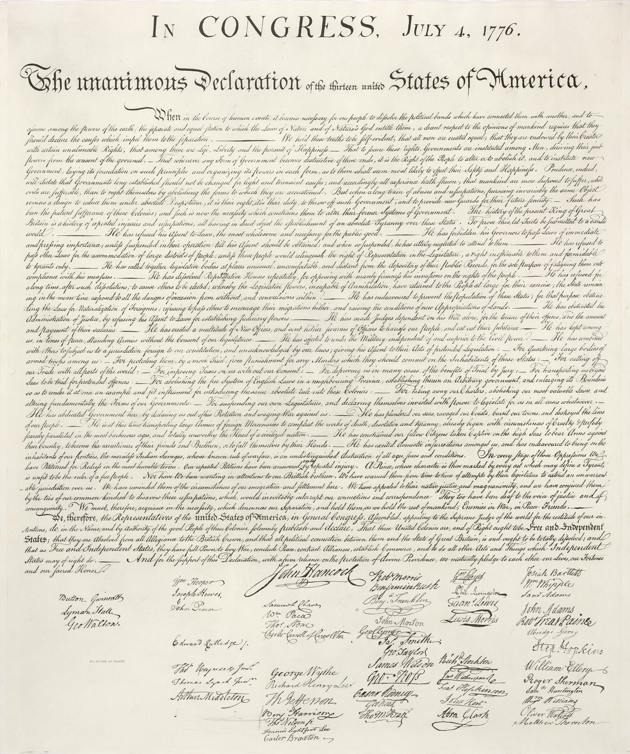
Copperplate is the main lettering style in the body of the Declaration of Independence and also among the signatures. John Hancock’s signature stands out. It’s likely because he may have been the first to sign it. His name is an informal synonym for ‘signature’. National Handwriting Day is held on his birthday January 23. Hancock was not a master penman, he was however the 1st and 3rd Governor of Massachusetts and the 4th President of the Continental Congress.

Many American’s (above 30 years of age) have a connection to ornamental penmanship through the many hours spent, in elementary school, learning the Palmer Method of handwriting, which was based on the Spencerian system of writing. The Palmer Method is far less ornate and faster to write than Spencerian.

Palmer Method

The Palmer Method, developed by Austin Norman Palmer, was adopted as the standard handwriting system in public schools in the early 20th century (New York City 1905).

Resources:

Promoting the Art of Ornamental Penmanship: zanerian.com

International Association of Master Penmen, Engrossers and Teachers of Handwriting  |  Society of Scribes  |  AVA Gallery  |  Michael Sull, Master Penman  |  Masscribes  |  Association for the Calligraphic Arts  |  John Neal Bookseller  |  Paper & Ink Arts